A Trello alternative for what you never wrote down
Trello and Wasp look adjacent and are solving different halves of the problem. An honest comparison, including where Trello is the better choice.
The short version
Trello is a board a whole team can see, and its Inbox now uses AI to turn an email you forward into a tidy card. The forwarding is still yours to do. Wasp reads the mailbox itself, including the promises in what you sent, and then escalates until every one is answered. Trello is the better team tool and costs a fraction as much.
Why people look for a Trello alternative
Trello is the board. Lists, cards and drag and drop, shared with whoever else is working on the same thing, and it has been the default answer to that job for well over a decade. Recent versions add an Inbox for loose items and a Planner view for dropping cards onto a calendar, so it is no longer only a board.
Two reasons come up. The first is that a board is built for work everyone can see, and a lot of what a person owes is owed alone, so it never earns a card. The second is quieter and is the one this page is about: the Inbox is genuinely good at filing something once you send it there, and the commitments that get dropped are the ones nobody thought to send anywhere.
What Trello is genuinely good at
Trello is a better team tool than Wasp and is not trying to be beaten at it. Shared boards, assignment, Power-Ups, a free plan that real teams run on, and a paid tier at roughly the price of a coffee. The AI Inbox is a real capability rather than a checkbox: forward a message and it writes the title, reads out a due date and builds a checklist. If the problem is coordinating people, buy Trello and stop reading.
This page is not going to pretend otherwise. If the paragraph above describes your problem, the honest recommendation is to stay where you are.
Where the two diverge
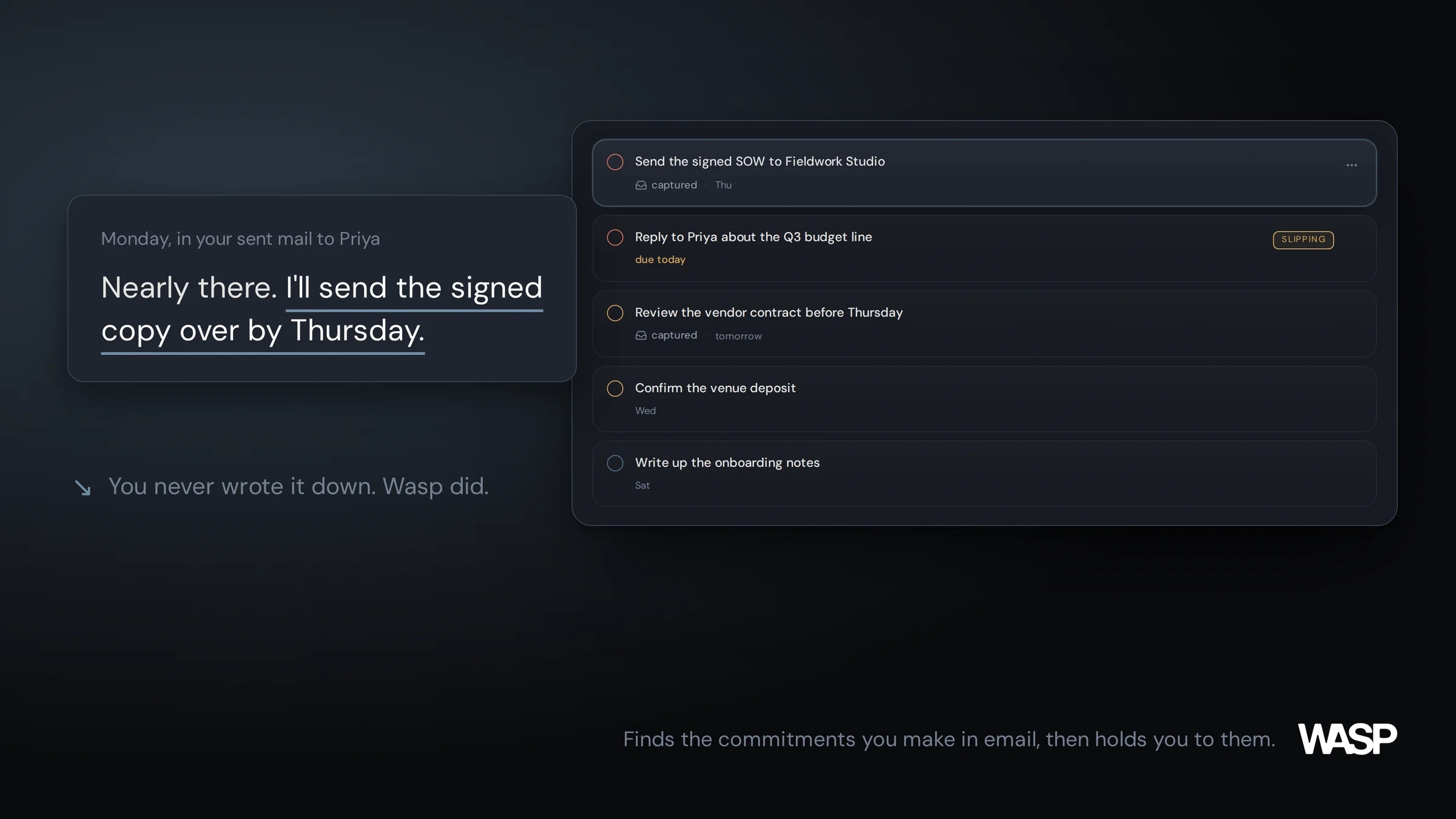
Trello's Inbox waits to be handed things. Forwarding an email, reacting to a Slack message, tapping a note into the app: each one is a decision made about one item, at the moment you already knew it mattered. The commitments that cost you are the ones you never flagged, because at the time they read as an ordinary sentence in an ordinary reply. Wasp watches the accounts themselves and surfaces those without being told, confidence-gated so low-signal noise never reaches you.
The second half is what happens afterwards. A Trello due date warns you once, turns red, and then sits there, and a card pushed forward fifteen times looks exactly like a card pushed forward once. Wasp escalates through four rungs of rising pressure that accept any answer except silence, and it records which kinds of commitment you tend to let slide so it pushes earlier on those next time.
Wasp reads Gmail, Google Calendar, Slack and on-device capture, and detects commitments as they appear, confidence-gated so low-signal noise never surfaces. It also reads what you send, which is the part nothing else does: a line like "I will get you the numbers by Friday" takes ten seconds to type and is gone from memory in five minutes. Wasp keeps it, then holds you to it.
Wasp and Trello, side by side
| Wasp | Trello | |
|---|---|---|
| What it is for | Catching commitments you did not record, then making them happen | Organizing work on a board a team can see |
| Finds work you never entered | Yes, from Gmail, Google Calendar, Slack and the desktop | No, you enter it |
| Reads your outgoing messages for promises you made | Yes | No |
| Escalates when you stall | Yes, four rungs, and it requires an answer | No, the due date turns red and waits |
| Learns your personal follow-through pattern | Yes, over weeks | No |
| Auto-schedules your calendar | No, it places a focus block only when you choose that | No, Planner is drag and drop by hand |
| Price | Essentials 15/mo, Pro 35/mo | Free, Standard 5, Premium 10/user |
| Trial | 14 days of full Pro, no card until it ends | Free plan, paid tiers offer a trial |
| Available today | Pre-launch, waitlist open | Yes |
Trello pricing read from their own pricing page on 7 September 2026. Prices move: check before deciding on the strength of this table.
Which one to choose
Choose Trello if
Choose Trello if the work involves other people and needs to sit somewhere everyone can see it, or the budget matters. Wasp is built around one person's own commitments and has no shared boards at all.
Choose Wasp if
Choose Wasp if the things going wrong are yours alone, nobody else is going to chase them, and they were never going to reach a board because nobody stopped to make a card.
Choose both, honestly
They are not mutually exclusive. Wasp is the layer that catches what never got recorded and then applies pressure, and it is compatible with keeping Trello for what it is already doing well.
Where Wasp is today, plainly
Wasp is pre-launch. The product is built and the waitlist is open, and there is nothing to buy yet. If you need to move off Trello this week, Wasp cannot help this week, and it would be a poor comparison page that let you find that out later.
There are no customer testimonials on this page because there are no customers yet. Rather than borrow someone else's quotes or manufacture any, here is what can be checked instead: the live demo runs the real interface on invented data with no account needed, and the changelog lists what has shipped and when.
Questions
Trello has an AI Inbox now. Is that the same thing Wasp does?
They meet in the middle and start from opposite ends. Trello's Inbox does good work on an item once it arrives, and it arrives because you forwarded it, reacted to it or typed it. That is a decision per item, made when you already knew the thing mattered. Wasp is pointed at the case where you did not: it reads Gmail, Google Calendar, Slack and meeting transcripts continuously and surfaces commitments nobody flagged. Wasp also reads what you send, which is the part nothing else on the market does.
Can Wasp replace Trello?
For personal commitments, yes: Wasp has a unified list, a calendar, manual capture and notes. For team work, no, and not by accident. Trello is a shared board with assignment and collaboration, and Wasp has none of that. Plenty of people would sensibly run both.
Trello costs a few dollars a user. Why does Wasp cost so much more?
Because it is doing a different and more expensive job. Trello stores and shares cards people made. Wasp reads across your connected accounts and runs language models over that continuously to find commitments nobody entered, then tracks each one to an answer. If a board you fill in yourself is working, Trello is the better buy.
Next
Joining the waitlist puts you in the queue for early access as it rolls out in waves. It costs nothing and there is no card involved.
Other comparisons: all alternatives. Not sure Wasp fits how you work? See who Wasp is for. Still deciding what Wasp actually does? The FAQ is the short version.