A Meta Muse alternative for what you never wrote down
Meta Muse and Wasp look adjacent and are solving different halves of the problem. An honest comparison, including where Meta Muse is the better choice.
The short version
Muse is Meta's personal agent. Give it a goal and it goes and does the work: books the restaurant, fills in the form, buys the thing, sends the email once you approve it. Wasp is pointed at the half nobody can do for you, which is what you told another person you would do yourself. Muse is free, it covers far more ground, and it is currently available in the United States only.
Why people look for a Meta Muse alternative
Muse is Meta's personal AI agent, launched on 8 September 2026. It runs on a virtual machine in Meta's cloud with a browser you can watch working, connects to Gmail, Google Calendar, Outlook and a long list of other services, remembers what you tell it between conversations, and carries on working after you close the app. Give it a goal and it breaks that into steps and works through them, stopping to ask before it sends an email or spends money.
Two reasons, and the first is simply practical: Muse is available in the United States only, with no announced date for anywhere else, so most people who read about it cannot open it. The second is the one this page is about. An agent that does things for you is a genuinely useful thing to own, and it is a different thing from something that makes sure you do what you said you would.
What Meta Muse is genuinely good at
Muse is free for most people, the free allowance is large, and it does far more kinds of thing than Wasp does. It really does act rather than advise: it opens a browser, fills in the form, compares the options and completes the purchase, and it can check out at over a million businesses through a single-use card so the merchant never sees your real details. If what you want is an assistant that books the table, renews the thing and chases the refund, Muse does all of that and Wasp does none of it.
This page is not going to pretend otherwise. If the paragraph above describes your problem, the honest recommendation is to stay where you are.
Where the two diverge
Muse works from a goal you hand it, and it is excellent at that. The commitments that actually cost you are the ones you never handed to anything, because at the time they read as an ordinary sentence in an ordinary reply, and nobody sets a goal about a line they have already forgotten writing. Wasp starts one step earlier than that, before anything has been decided, recorded or handed anywhere.
The second difference is the one that decides which of these you need. Muse takes work off your plate, and that works right up to the work that cannot leave it. Nobody can have the difficult conversation with your client for you, review the draft in your name or call your father back. For those, an offer to do it for you is not help. Wasp escalates through four rungs of rising pressure that accept any answer except silence, and it records which kinds of commitment you tend to let slide so it pushes earlier on those next time.
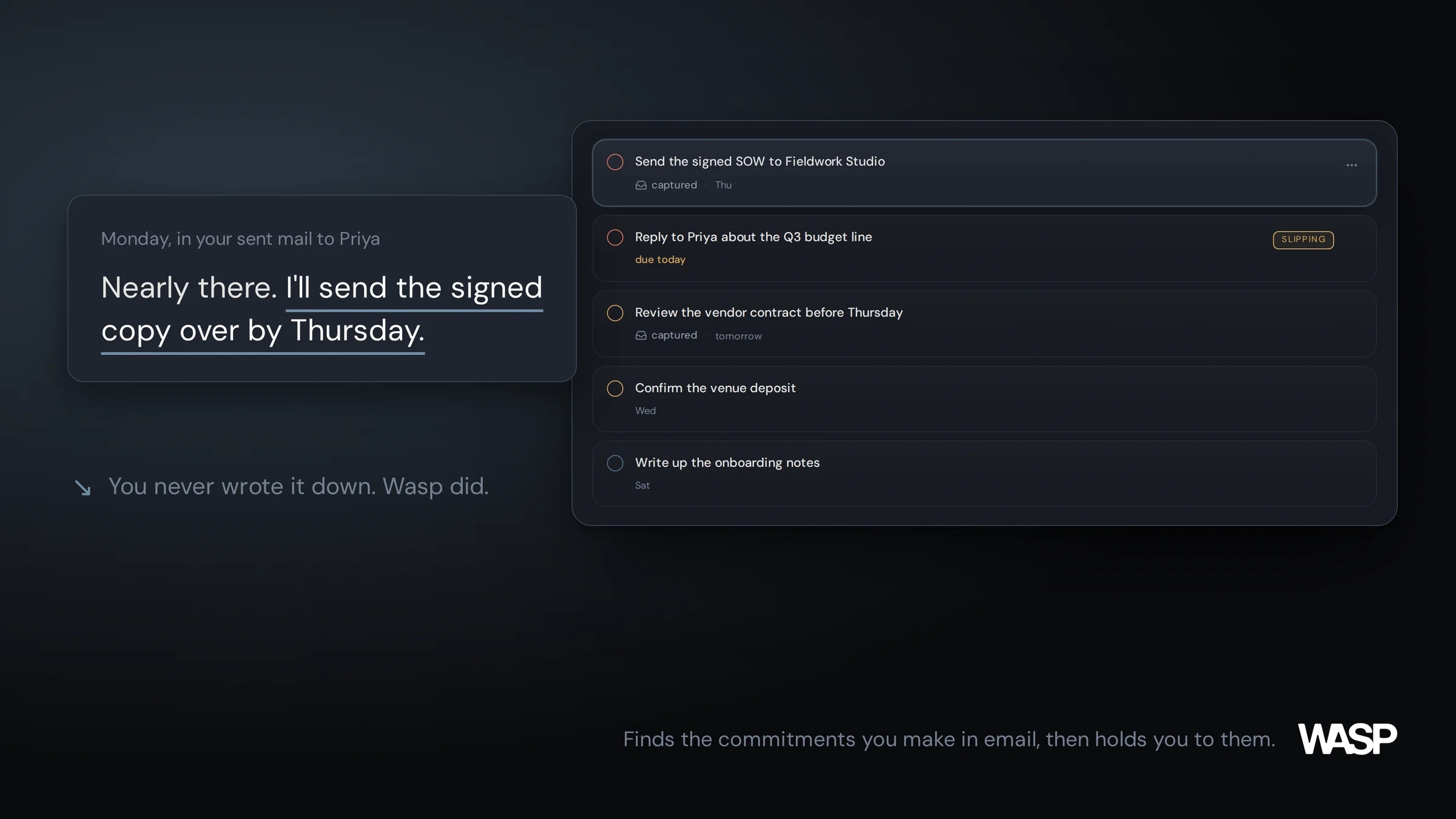
Wasp reads Gmail, Google Calendar, Slack and on-device capture, and detects commitments as they appear, confidence-gated so low-signal noise never surfaces. It also reads what you send, which is the part nothing else does: a line like "I will get you the numbers by Friday" takes ten seconds to type and is gone from memory in five minutes. Wasp keeps it, then holds you to it.
Wasp and Meta Muse, side by side
| Wasp | Meta Muse | |
|---|---|---|
| What it is for | Catching commitments you did not record, then making sure you keep them | Doing errands and multi-step tasks on your behalf |
| Connects to Gmail and Google Calendar | Yes | Yes |
| Finds commitments nobody flagged, without being asked | Yes, continuously, across every connected account | It watches what you set a goal about |
| Reads your outgoing messages for promises you made | Yes | No |
| Chases you when you go quiet | Yes, four rungs of rising pressure, and it requires an answer | No, it does the task instead |
| Learns your personal follow-through pattern | Yes, over weeks, and pushes earlier on the kinds you tend to let slide | It remembers your preferences, not your follow-through |
| Acts for you: buys, books, fills in forms | No, that is not what it is for | Yes, with your approval on spending and sending |
| Price | Essentials 15/mo, Pro 35/mo | Free, Power 20/mo, Maximum 100/mo |
| Available today | Pre-launch, waitlist open | United States only, 18 and over |
Muse launched on 8 September 2026 and its prices here were compiled from published launch coverage on 10 September 2026 rather than read from Meta's own page, which is not reachable from where this page is built. Muse is two days old and still changing; check before deciding anything on the strength of this table.
Which one to choose
Choose Meta Muse if
Choose Meta Muse if the jobs going undone can genuinely be done by somebody who is not you: booking, buying, filling in forms, comparing options, chasing a refund. Muse does those, it does them for free, and Wasp does not do them at all. It also helps to be in the United States.
Choose Wasp if
Choose Wasp if the things going wrong are the ones only you can do, nobody else is going to chase them, and being reminded once has repeatedly not been enough to make them happen.
Choose both, honestly
They are not mutually exclusive. Wasp is the layer that catches what never got recorded and then applies pressure, and it is compatible with keeping Meta Muse for what it is already doing well.
Where Wasp is today, plainly
Wasp is pre-launch. The product is built and the waitlist is open, and there is nothing to buy yet. If you need to move off Meta Muse this week, Wasp cannot help this week, and it would be a poor comparison page that let you find that out later.
There are no customer testimonials on this page because there are no customers yet. Rather than borrow someone else's quotes or manufacture any, here is what can be checked instead: the live demo runs the real interface on invented data with no account needed, and the changelog lists what has shipped and when.
Questions
Is Wasp a smaller version of Meta Muse?
No, and the difference is not size. Muse is a doer: it takes a goal and does the work. Wasp is built for the work that cannot be delegated to anybody, which is what you told another person you would do yourself. Handing that to an agent is not an option, so what matters is whether something notices you have not done it and keeps asking. That is what Wasp does and it is not what Muse is for.
Muse is free. Why does Wasp cost 15 or 35 dollars a month?
Because they make money in different places. Meta has said it is considering taking a percentage of purchases its agent makes, so a free agent that buys things is a route to being the checkout rather than a price. Wasp sells a subscription and nothing else: it takes no cut of anything, sells nothing to advertisers and has no reason to prefer one merchant over another, because it is not buying anything. And if a free agent solves your problem, the honest answer is to use the free agent.
Can Muse be used outside the United States?
Not yet. Muse launched in the United States for people aged 18 and over, and Meta has announced no date for anywhere else. Meta AI itself has been available across much of the world for a while, so the groundwork exists, but reading an inbox and spending money is a much larger permission than answering questions. Wasp is pre-launch everywhere, so today neither one is something you can go and buy.
Does Muse track promises you made to other people?
Nothing in its launch material describes that. Muse reads your inbox in service of a goal you gave it, and its memory is for your preferences. Wasp reads what you send and detects commitments in your own words, then tracks each one until it is kept, renegotiated or dropped. That capability is the reason Wasp exists and it is currently the thing nothing else on the market offers.
What does each one do with what it reads?
Meta says Muse conversations are not shared with its advertising systems, and that sanitized records of conversations and tasks may be used to train its models, with an opt-out in settings. Wasp processes a message and discards it: only derived text is stored, never the body, your data is never used to train a model, and the engine never decides to send anything on your behalf. Those are checkable claims rather than reassurances, and the privacy policy spells out each one.
Next
Joining the waitlist puts you in the queue for early access as it rolls out in waves. It costs nothing and there is no card involved.
Other comparisons: all alternatives. Not sure Wasp fits how you work? See who Wasp is for. Still deciding what Wasp actually does? The FAQ is the short version.